Audio Filter Butterworth
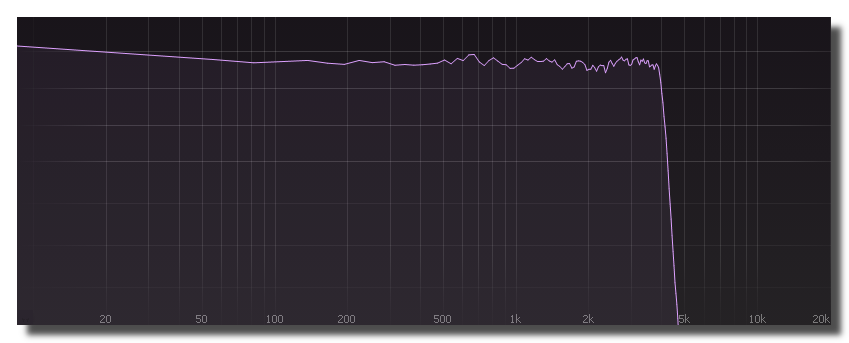
Nth order Butterworth audio filters, LP/HP up to 192 dB per octave. It's the most efficient audio filter in Usine. The response is maximally flat in the passband; each order adds 6 dB/octave of attenuation: order 4 (default) gives 24 dB/octave.
Settings
query
Number of audio channels, asked when the module is created (1 = mono, 2 = stereo, up to 192). Each channel is processed independently and the module exposes one in N / out N pair per channel: with 1 channel only in 1 and out 1 exist.
Choose the number of channels actually carried by the signal. A mono source feeds a 1-channel module; duplicate the signal only where a stereo output is needed. To change the number of channels afterwards, recreate the module: the query is asked again and the connections are restored by name.
bypass
Bypasses the module processing when activated (ON).
- OFF (0): Module processes normally
- ON (1): Input passes directly to output without processing
in
Audio input flow(s).
out
Audio output flow(s).
gain
Output gain of the filter, from -80 to +12 dB (default 0 dB). Changes are smoothed.
frequency
Filter frequency.
order
Order of the filter, from 1 (6 dB/octave) to 32 (192 dB/octave), default 4.
type
Filter type:
- LowPass: only passes low and filters high frequencies.
- HighPass: only passes high and filters low frequencies.
channels to process
Array of the channel numbers to filter, from 1 to the number of channels: for example 1,3 filters only the channels 1 and 3, the other channels are copied unchanged to their outputs. Empty or 0 (default): all channels are filtered. Reducing the list saves CPU.
Inlet visible only if the number of audio channels is > 2
Common Settings
info
show manual
Button. Opens the manual page of the selected object (or of its parent module for a control) in the web browser. If no page exists for this object, an error is traced in the trace panel.
For more details about information/help creation, see create-help-file.
description
Free multi-line text attached to the module, saved with the patch. When it is not empty, it is shown as the hint of the module (mouse over the module header in the patch) in place of the default module hint, even when the module hints are disabled.
ID's
visible only in god mode, see setup-panel-tab-expert.
unique ID
Read-only, not saved. Current private numeric ID of the object, used internally to identify it (for example as the target of a bind ID).
preset ID
Read-only, not saved. Private ID used to store and recall the values of this control in presets.
recreate ID
Button. Generates a new unique ID, original ID and preset ID for the object. Use it if you experience difficulties in Polyphonic mode or if two objects share the same ID. Preset values and binds referring to the old IDs are lost.
Object Remote Address
absolute
Read-only, not saved. Absolute address of the object in the Usine objects tree, built from the workspace root. This is the address to use to reach the object from scripts, the objects panel or remote messages. Only shown for objects that are registered in the objects list. See objects-address.
local
Read-only, not saved. Address of the object relative to the current patch, valid inside that patch only. See objects-address.
user addr
Free user-defined address for the object (empty by default). When set, the object is also registered in the objects tree under this name, so it can be reached independently of its position in the workspace (the value is also reported in the mouse-over and mouse-down chunks). Changing it rebuilds the objects list. Only available on objects that support a user address. See objects-address.
See also
- FILTER Simple
- FILTER Vocoder
- FILTER Time Curve
- FILTER Parametric EQ
- FILTER Resonator
- FILTER Formant
- Audio Filter Parametric EQ Legacy
- Audio Filter Vocoder Legacy
- Filters
- Audio Filter Waveguide
- Audio Filter Multi Bandpass
- Audio Filter Butterworth
- Audio Filter Oberheim SEM
- Audio Filter Comb
- Audio Filter Formant Morph
- Audio Filter Resonator
- Audio Filter Moog
- Audio Filter DC Blocker
- Audio Filter Biquad
- Audio Filter One Pole
- Audio Filter Equalizer
- Audio Filter Linkwitz Riley
- Audio Filter Vocoder
- Audio Filter Korg MS-20
- Audio Filter Transients
- Audio Filter Steiner
- Audio Filter Simple
- Audio Filter FIR
- Audio Filter Diode Ladder
- Audio Filter Dynamic EQ
- Audio Filter Formant
version 7.0.250921
Edit All Pages