GRAIN Ritual
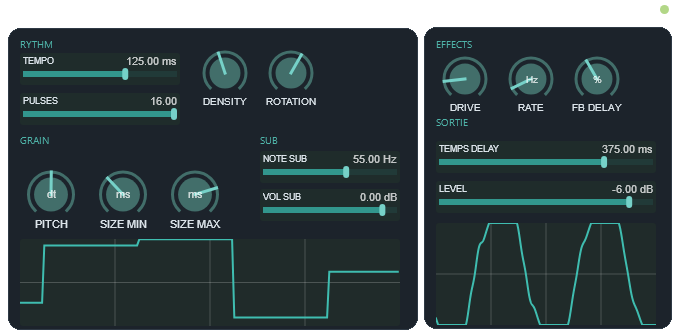
Rhythmic granular effect: cuts the audio input into grains on a euclidean rhythm and adds a sub that plays its own euclidean rhythm. A granulator starts one grain at each pulse of a 16-step euclidean rhythm, thinned out by a probability gate; the pitch and the length of each grain are drawn at random. A second euclidean rhythm, 3 pulses in 8 steps on the same clock, strikes a sine sub through a short envelope.
The grains and the sub then go through a tanh wave shaper, a phaser, a delay, the output volume and a limiter. The patch is 100 % wet: the input is heard only through the grains. Audio in 1-2, audio out 1-2.
Play a voice or a sustained sound. Lower PULSES (5 or 7 for example) and turn ROTATION to change the rhythm of the grains, then DENSITY to leave some of them out.
In the library: 1-Audio > Audio Granular.
Settings
Rhythm
The RYTHM zone sets the rhythm that starts the grains.
TEMPO
Time between two steps of the rhythms, from 30 to 500 ms (log scale). It sets the speed of the grain rhythm and of the sub rhythm.
PULSES
Number of pulses spread over the 16 steps of the grain rhythm, from 0 to 16: at 16 every step starts a grain, at 0 no grain is played.
DENSITY
Probability that a pulse starts a grain, from 0 (never) to 1 (always).
ROTATION
Shifts the grain rhythm by 0 to 16 steps. The sub rhythm does not move.
Grain
PITCH
Range of the random transposition of the grains, from 0 to 24 semitones (shown dt): each grain gets a pitch drawn between -PITCH and +PITCH. At 0, the grains keep the pitch of the input.
SIZE MIN
Shortest length of the grains, from 10 to 400 ms.
SIZE MAX
Longest length of the grains, from 10 to 400 ms. Each grain gets a length drawn between SIZE MIN and SIZE MAX.
grain size display
The display under the knobs draws the length of the last grains over one second, from SIZE MIN (bottom) to SIZE MAX (top).
The grains have a Hanning envelope, set in the Granulator module inside the patch.
Sub
A sine wave struck by a fixed euclidean rhythm of 3 pulses in 8 steps on the TEMPO clock, through a short envelope (3 ms attack, 160 ms decay, 120 ms release). It is mixed into both output channels.
NOTE SUB
Frequency of the sub, from 25 to 220 Hz (log scale).
VOL SUB
Level of the sub, from -60 to 6 dB.
Effects
DRIVE
Drive of the tanh saturation, from 1 to 100. A slow LFO adds a variation of ±4 to it (one cycle in about 17 s).
RATE
Speed of the phaser, from 0 to 5 Hz. The phaser sweeps between 300 and 2500 Hz.
FB DELAY
Feedback of the delay, from 0 to 90 %.
Output
The SORTIE zone.
DELAY TIME
Delay time, from 10 to 1000 ms (log scale).
LEVEL
Output volume, from -60 to 0 dB, before the limiter.
output display
The display under LEVEL draws the left channel of the output over the last 10 seconds.
See also
version 7.0.250921
Edit All Pages