Video Geometric Kaleidoscope
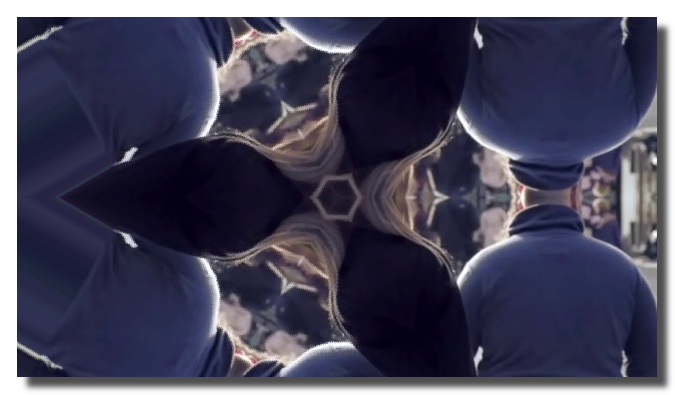
Creates a parametric kaleidoscope effect by mirroring a sector of the image around a center point.
The image is divided into segments equal sectors around the center. The sector centered on the axis of the long side of the image keeps the image as it is; the other sectors show it again around the center, turned, and mirrored in every other one, so that the pattern stays centered whatever the shape of the image:
- on a landscape or square image, the sector that keeps the image is the one on the right of the center, centered on the horizontal line through the center (with the default 6 segments it spans 30 degrees above that line and 30 degrees below it);
- on a portrait image (taller than wide), the same pattern is turned by a quarter of a turn: the sector that keeps the image is the one below the center, centered on the vertical line through the center.
Each pixel keeps its distance to the center, so the pixels far from the center can take points outside the image: these points are mirrored back into the image at the edges they cross, as if the image continued as its own reflection.
What to expect
- With 2 segments the right half of a landscape or square image stays as it is and is mirrored onto the left half; on a portrait image the lower half is mirrored onto the upper half.
- With 2, 6, 10... segments the pattern is symmetric about the vertical line through the center of a landscape or square image (about the horizontal line through the center of a portrait image); with 4, 8, 12... segments it is symmetric about the center itself.
- With an odd number of segments the pattern does not join along one line from the center: the upper edge of the sector that keeps the image (its right edge on a portrait image).
- With the default settings almost no pixel of a 16:9 or 9:16 image takes points outside the image (only its first column, or the first row of a 9:16 image), nor with 2 or 4 segments; about one in fifty does with 8 segments and one in ten with 3. A square image takes more: about one pixel in six with 6 segments, in its four corners.
- The center changes that share. As it moves towards the edge that the kept sector faces (the right edge of a landscape or square image, the bottom edge of a portrait image), more and more pixels take points outside the image: with the default 6 segments about six pixels in ten of a 16:9 image and eight in ten of a square one at center x 0.75 (center y 0.75 on a portrait image), the whole image at 1. Moving it towards the two edges along the axis (center y on a landscape or square image, center x on a portrait image) adds fewer: about three pixels in ten of a 16:9 image at 0.1 or 0.9 and half of it at 0 or 1, about half and seven in ten of a square image. Moving it towards the opposite edge (center x towards 0, or center y towards 0 on a portrait image) adds none with the default 6 segments.
- When the image turns from landscape to portrait, or back, the pattern turns with it.
The mapping is computed again when a setting or the image size changes. With fixed settings each frame only moves the pixels along the stored mapping, which costs little; a setting that changes on every frame costs a full computation on every frame.
Settings
bypass
Bypasses the module processing when activated (ON).
- OFF (0): Module processes normally
- ON (1): Input passes directly to output without processing
video in
Video input flow(s).
video out
Video output flow(s).
process time
Total time used for the calculation of the module.
segments
Number of kaleidoscope segments, from 2 to 32; 6 by default.
center x
Horizontal position of the center of the effect, from 0 (left edge) to 1 (right edge); 0.5 by default.
center y
Vertical position of the center of the effect, from 0 to 1 across the height of the image; 0.5 by default.
Common Settings
info
show manual
Button. Opens the manual page of the selected object (or of its parent module for a control) in the web browser. If no page exists for this object, an error is traced in the trace panel.
For more details about information/help creation, see create-help-file.
description
Free multi-line text attached to the module, saved with the patch. When it is not empty, it is shown as the hint of the module (mouse over the module header in the patch) in place of the default module hint, even when the module hints are disabled.
ID's
visible only in god mode, see setup-panel-tab-expert.
unique ID
Read-only, not saved. Current private numeric ID of the object, used internally to identify it (for example as the target of a bind ID).
preset ID
Read-only, not saved. Private ID used to store and recall the values of this control in presets.
recreate ID
Button. Generates a new unique ID, original ID and preset ID for the object. Use it if you experience difficulties in Polyphonic mode or if two objects share the same ID. Preset values and binds referring to the old IDs are lost.
Object Remote Address
absolute
Read-only, not saved. Absolute address of the object in the Usine objects tree, built from the workspace root. This is the address to use to reach the object from scripts, the objects panel or remote messages. Only shown for objects that are registered in the objects list. See objects-address.
local
Read-only, not saved. Address of the object relative to the current patch, valid inside that patch only. See objects-address.
user addr
Free user-defined address for the object (empty by default). When set, the object is also registered in the objects tree under this name, so it can be reached independently of its position in the workspace (the value is also reported in the mouse-over and mouse-down chunks). Changing it rebuilds the objects list. Only available on objects that support a user address. See objects-address.
See also
- Video Geometric Kaleidoscope
- Video Geometric Downsample
- Video Geometric Mirror Left
- Video Geometric Resize
- Video Geometric Bands
- Video Geometric Swirl
- Video Geometric Shuffle
- Video Geometric Flip Horizontal
- Video Displacement Map
- Video Geometric Mirror Top
- Video Geometric Polar
- Video Geometric Get Size
- Video Geometric Upsample
- Video Geometric Change Aspect Ratio
- Video Geometric Fish Eye
- Video Geometric Luma Displace
- Video Geometric Bulge
- Video Geometric Ripple
- Video Geometric Flip Vertical
- Video Geometric Tile
version 7.0.250921
Edit All Pages