Audio Analysis Zero Crossing
Zero crossing rate calculation. This rate corresponds to the number of times that the sound value (waveform) passes through the zero.
Typically, the more the sound is harmonically complex, the more the zero crossing rate value is high.
You can use it to make differences between vowels or consonants sounds, or the difference between snare, bass or cymbals on drums.
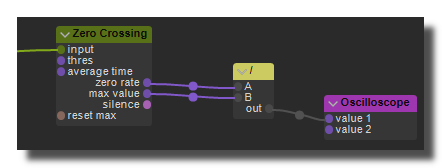
In the example below, we can see on the panel-oscilloscope-data module the result of the zero crossing rate analysis on a simple drum loop.
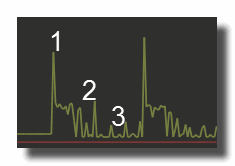
- 1: Kick
- 2: Snare
- 3: cymbal
Settings
in
Audio input flow(s).
threshold
Detection threshold. The calculation is done only if the input sound intensity is greater than the threshold value.
average time
Average time. The calculation is done during a time interval.
Use small values for quick variations or high for slow variations.
zero rate
Zero crossing rate output in Hz.
max value
Calculated zero crossing rate maximum value.
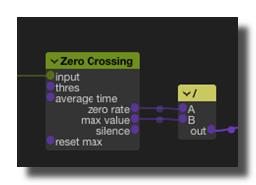
As in the example above, it's often more interesting to get the relative variations rather than the absolute. You can use the division math module to achieve this.
silence
Silence indicator. Sends a 1 value when the audio input intensity is under the detection threshold and a 0 when above.
reset max
Resets to 0 the calculated Max Zero Crossing value.
Common Settings
info
show manual
Button. Opens the manual page of the selected object (or of its parent module for a control) in the web browser. If no page exists for this object, an error is traced in the trace panel.
For more details about information/help creation, see create-help-file.
description
Free multi-line text attached to the module, saved with the patch. It is only meant as an internal note for the patch designer: it is not displayed in the interface.
ID's
visible only in god mode, see setup-panel-tab-expert.
unique ID
Read-only, not saved. Current private numeric ID of the object, used internally to identify it (for example as the target of a bind ID).
preset ID
Read-only, not saved. Private ID used to store and recall the values of this control in presets.
recreate ID
Button. Generates a new unique ID, original ID and preset ID for the object. Use it if you experience difficulties in Polyphonic mode or if two objects share the same ID. Preset values and binds referring to the old IDs are lost.
Object Remote Address
absolute
Read-only, not saved. Absolute address of the object in the Usine objects tree, built from the workspace root. This is the address to use to reach the object from scripts, the objects panel or remote messages. Only shown for objects that are registered in the objects list. See objects-address.
local
Read-only, not saved. Address of the object relative to the current patch, valid inside that patch only. See objects-address.
user addr
Free user-defined address for the object (empty by default). When set, the object is also registered in the objects tree under this name, so it can be reached independently of its position in the workspace (the value is also reported in the mouse-over and mouse-down chunks). Changing it rebuilds the objects list. Only available on objects that support a user address. See objects-address.
See also
- Audio Analysis Beat Follower Threshold (SUB-PATCH)
- Audio Analysis Beat Follower (SUB-PATCH)
- Analysis
- Audio Analysis Tuner
- Audio Analysis Sonogram
- Audio Analysis Partial Tracker
- Audio Analysis Envelope Follower
- Audio Analysis To MIDI
- Audio Analysis Transient Detector
- Audio Analysis Peak Detector
- Audio Analysis Descriptors
- Audio Analysis Kick Detector
- Audio Analysis Zero Crossing
- Audio Analysis BPM Detector
version 7.0.250921
Edit All Pages