Data Generator Perlin Noise
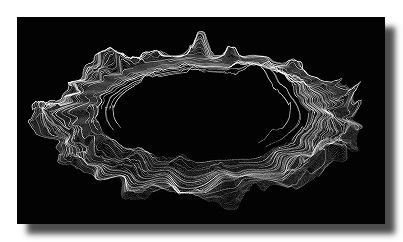
Generates 1D Perlin noise. Unlike plain random values which jump abruptly, Perlin noise produces smooth, organic-looking randomness where each value flows naturally into the next. This makes it ideal for natural-feeling modulation such as subtle vibrato, drifting filter cutoffs, procedural animation, or any parameter that should wander smoothly rather than jump. See https://en.wikipedia.org/wiki/Perlin_noise.
Settings
on
Activates or deactivates the module.
out
Output Data flow(s).
min
Minimum value of the output.
max
Maximum value of the output.
frequency
Base noise frequency. Higher values produce faster variations.
octaves
Number of noise octaves layered together. More octaves add finer detail on top of the base shape.
persistence
Controls how much each successive octave contributes. Lower values make higher octaves fade out quickly (smoother result); higher values keep the fine detail prominent.
increment time
Speed of the generator engine. Controls how fast the noise evolves over time.
synchro
Synchro mode:
- always: continuously generates data.
- trigger input: generates a new value only when trigger in receives a trigger.
trigger in
Generates a new random value.
Only when synchro = trigger input.
restart
Restarts the generator from the beginning.
random seed
Generates a new set of Perlin constants to create a different variation of the noise pattern.
Common Settings
info
show manual
Button. Opens the manual page of the selected object (or of its parent module for a control) in the web browser. If no page exists for this object, an error is traced in the trace panel.
For more details about information/help creation, see create-help-file.
description
Free multi-line text attached to the module, saved with the patch. It is only meant as an internal note for the patch designer: it is not displayed in the interface.
ID's
visible only in god mode, see setup-panel-tab-expert.
unique ID
Read-only, not saved. Current private numeric ID of the object, used internally to identify it (for example as the target of a bind ID).
preset ID
Read-only, not saved. Private ID used to store and recall the values of this control in presets.
recreate ID
Button. Generates a new unique ID, original ID and preset ID for the object. Use it if you experience difficulties in Polyphonic mode or if two objects share the same ID. Preset values and binds referring to the old IDs are lost.
Object Remote Address
absolute
Read-only, not saved. Absolute address of the object in the Usine objects tree, built from the workspace root. This is the address to use to reach the object from scripts, the objects panel or remote messages. Only shown for objects that are registered in the objects list. See objects-address.
local
Read-only, not saved. Address of the object relative to the current patch, valid inside that patch only. See objects-address.
user addr
Free user-defined address for the object (empty by default). When set, the object is also registered in the objects tree under this name, so it can be reached independently of its position in the workspace (the value is also reported in the mouse-over and mouse-down chunks). Changing it rebuilds the objects list. Only available on objects that support a user address. See objects-address.
See also
- Generators
- Data Generator Turing Machine
- Data Generator Pattern
- Data Generator Sequenced Lines
- Data Generator Random Urn
- Data Generator Burst
- Data Generator Sequenced Triggers
- Data Generator ADSR
- Data Generator Sequenced Switches
- Data Generator LFO
- Data Generator Sequenced Steps
- Data Generator Random
- Data Generator Sequenced Points Curve
- Data Generator Ramp
- Data Generator Random Pattern Array (SCRIPT)
- Data Generator Chaos Rossler
- Data Generator Chaos Lorenz
- Data Generator Perlin Noise
- Data Generator Euclidean Rhythm
- Data Generator Grain
- Data Generator Random Walk
- Data Probability Gate
version 7.0.250921
Edit All Pages