SYNTH Lorenz Bell Garden
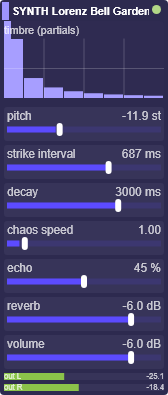
Generative bell garden: two additive bell voices are struck by two clocks in golden ratio, and each strike draws a note at random in a pentatonic scale. A Lorenz attractor is the wind: its x value sets the brightness (timbre) of the bells and its y value the density of the strikes.
Each voice is an audio-oscillator-additive with 8 partials and an ADSR envelope; the amplitude of the partial k is 1 / k^brightness. Voice A is a tubular chime (partials 1, 2.76, 5.40, 8.93 and 13.34, plus a sub and two beating pairs). Voice B is a glass bell one octave up, whose clock interval is multiplied by 1.618 so that the two voices never line up. The wind comes from a data-generator-chaos-lorenz. Crossed echoes (voice A to the right, voice B to the left), a reverb, a volume and a limiter follow. The patch has no input; the audio outputs are 2 channels.
Raise chaos speed and watch the timbre display move. Lower strike interval for a denser garden.
In the library: 1-Audio > Audio Synthesis.
Settings
timbre (partials)
Display of the levels of the 8 partials, from 0 to 1. It moves with the brightness set by the wind.
pitch
Transposition of both voices, from -24 to 12 halftones (st).
strike interval
Time between two strikes, from 120 to 3000 ms. Voice B strikes 1.618 times less often. The lower, the denser the garden.
decay
Decay time of the bells, from 200 to 10000 ms. Shared by both voices.
chaos speed
Speed of the Lorenz attractor (the wind), from 0 to 10: the higher, the faster the brightness and the density change.
echo
Amount of the crossed echoes, from 0 to 90 %. Shared by both voices.
reverb
Level of the reverb, from -60 to 6 dB.
volume
Output volume, from -60 to 6 dB.
out L
Level meter of the left audio output.
out R
Level meter of the right audio output.
See also
version 7.0.250921
Edit All Pages