Video Draw Polyline
Draws a path joining the input points in order.
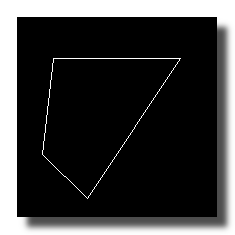
Coordinates X and Y are in the range [0..1] relative to the image size.
- the point
(0,0)is the upper left corner of the image. - the point
(1,1)is the bottom right corner of the image. - the point
(0.5,0.5)is the center of the image.
Formerly Video Draw Line to Path.
Settings
bypass
Bypasses the module processing when activated (ON).
- OFF (0): Module processes normally
- ON (1): Input passes directly to output without processing
video in
Video input flow(s).
- Can be connected to a video-generator-fill-color module or any video flow.
- To avoid aliasing it is recommended to use the same video resolution than the output screen.
video out
Video output flow(s).
process time
Total time used for the calculation of the module.
X1
Points X coordinates. The points of the arrays are joined in order by lines, and the first point of a frame is joined to the last point of the previous frame.
Y1
Points Y coordinates.
X2
Not used by this module.
Y2
Not used by this module.
color
Object color.
Can be a color array.
mode addition
When ON, the color is added to the pixels it draws: its red, green and blue values, multiplied by its alpha (from 0 to 1), are added to those of each pixel, up to 255. The alpha channel (transparency) of the video is kept. Each pixel of a line, an outline or a point is added once, the corners of the outline drawn by Draw Rect and the point where two lines of a path join included (the first point of a path that comes back to it too); a pixel where the items of the arrays overlap, or where the lines of a path cross, is added each time.
When OFF, the color is drawn over the pixels with its alpha as opacity: a color of alpha 1 (opaque) replaces them and a color of alpha 0 leaves them unchanged. In between, the video shows through: with the alphas from 0 to 1, each of red, green and blue becomes color x alpha + pixel x (1 - alpha), rounded, and the alpha of the pixel becomes alpha + pixel alpha x (1 - alpha), so that an opaque video stays opaque. On a video with transparency, a pixel that is not opaque is mixed according to its own alpha as well: each of its red, green and blue becomes (color x alpha + pixel x pixel alpha x (1 - alpha)) / new pixel alpha, so that once its transparency is applied it shows the color over the pixel. Each pixel of a line, an outline or a point is drawn once, the point where two lines of a path join included (the first point of a path that comes back to it too), with the color of the line that ends there; where two of them overlap, as the items of the arrays or the lines of a path that cross may, the later one is drawn over the earlier one.
A grid fade scales the alpha of the color, so that the drawing fades with it.
antialiased
When ON, the lines are drawn antialiased: along a line, each column (each row for a line higher than wide) is drawn on the two pixels nearest to the line, each with the part of the line that falls on it, from 0 to 1 (the two parts add up to 1); the pixels at the two ends of a line get half of their part. With mode addition OFF, the color is drawn over each of these pixels with its alpha multiplied by that part, rounded to 1/255, so that the line blends into the video (a pixel whose alpha rounds to 0 is left unchanged), and a line whose two ends fall on the same pixel is drawn there with the alpha of the color, as when antialiased is OFF. With mode addition ON, the red, green and blue values of the color multiplied by its alpha and by that part are added to those of the pixels, up to 255. Where two lines of a path join (Draw Polyline), the pixel of the joint gets the halves of both lines, its whole part: with mode addition OFF it is drawn once with the alpha of the color of the line that ends there, ON each line adds its half.
limit size
Limits the size of drawn lines: if the size of the line to draw is > limit size the line is ignored (not drawn).
The size is a fraction of the image width (horizontally) and height (vertically), from 0 to 1 (default 1: no limit).
reset
Resets all the values of the selected object.
It resets to the reset value value for controls and to their default values for panels.
Here, forgets the last point: the next point starts a new path.
Common Settings
info
show manual
Button. Opens the manual page of the selected object (or of its parent module for a control) in the web browser. If no page exists for this object, an error is traced in the trace panel.
For more details about information/help creation, see create-help-file.
description
Free multi-line text attached to the module, saved with the patch. When it is not empty, it is shown as the hint of the module (mouse over the module header in the patch) in place of the default module hint, even when the module hints are disabled.
ID's
visible only in god mode, see setup-panel-tab-expert.
unique ID
Read-only, not saved. Current private numeric ID of the object, used internally to identify it (for example as the target of a bind ID).
preset ID
Read-only, not saved. Private ID used to store and recall the values of this control in presets.
recreate ID
Button. Generates a new unique ID, original ID and preset ID for the object. Use it if you experience difficulties in Polyphonic mode or if two objects share the same ID. Preset values and binds referring to the old IDs are lost.
Object Remote Address
absolute
Read-only, not saved. Absolute address of the object in the Usine objects tree, built from the workspace root. This is the address to use to reach the object from scripts, the objects panel or remote messages. Only shown for objects that are registered in the objects list. See objects-address.
local
Read-only, not saved. Address of the object relative to the current patch, valid inside that patch only. See objects-address.
user addr
Free user-defined address for the object (empty by default). When set, the object is also registered in the objects tree under this name, so it can be reached independently of its position in the workspace (the value is also reported in the mouse-over and mouse-down chunks). Changing it rebuilds the objects list. Only available on objects that support a user address. See objects-address.
See also
version 7.0.250921
Edit All Pages