Input MIDI Global
Gets all incoming MIDI flow into Usine regardless of the source device.
See input-midi module for description.
Gets the incoming MIDI flow.
Settings
midi in
Received MIDI flow.
channel
Channel of the MIDI message.
msg
Type of the MIDI message.
data
Data 1 and data 2: first and second data of the MIDI message.
Depends of the message type.
For example data 1 = CONTROL-CHANGE number.
See MIDI implementation for more info.
trigger out
Sends a 1 value each time a new Data or MIDI message is generated or received.
trigger
Sends a 1 value each time a new Data or MIDI message is generated or received.
chan filter
Let passes only messages witch correspond to the channel filter. all channels: no channel filter, chan 1: only from channel 1, chan 2: only from channel 2
- etc.
filter
Message name to let pass.
-No filter-: all MIDI messages pass. NOTE ON/OFF/BEND: passes NOTE_ON, NOTE_OFF, PITCH_BEND, KEY_AFTERTOUCH, CHANNEL_AFTERTOUCH messages.
Useful to connect a MIDI keyboard to a VST/AU instrument, and filter Control Changes messages.
time
Time stamp of the MIDI message.
device name
Name of the device where the MIDI message comes from.
device ID
ID of the device where the MIDI message comes from. It's the order index in the setup-panel-tab-midi.
unpack
The Unpack option transforms a polyphonic flow to monophonic.
For example, if two MIDI Notes arrive at the same time,
Usine delays the second note a little to always create monophonic signal.
With this new MIDI flow, you can apply any math transformations you want because the MIDI flow become almost like a normal data flow.
sysex
Sysex array data received from the external MIDI device.
Usine removes automatically the BEGINSYSEX at the beginning and the ENDSYSEX at the end of the byte array.
single in poly
Determines if the module inlet/outlet appears only once in the polyphonic sub-patche, or if it is duplicated according the polyphony value.
Available only when the module is in a sub-patch.
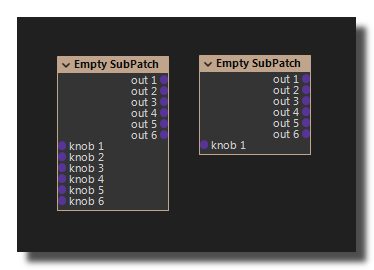
Example with a knob. First single in poly is OFF,(a polyphony of 6 creates 6 inlets) then option single in poly is ON and creates only 1 inlet.
The actual data type of a single in poly node is similar to an array. Once inspected you can see that it is an array the length of the nb of polyphony selected for that specific sub-patch. Although an array in data-type, single in poly disguises it's data representation and only addresses the first index by masking as a single-data node.
in outlet visible
Determines if the module is visible as an in/outlet in the sub-patch.
Common Settings
info
show manual
Button. Opens the manual page of the selected object (or of its parent module for a control) in the web browser. If no page exists for this object, an error is traced in the trace panel.
For more details about information/help creation, see create-help-file.
description
Free multi-line text attached to the module, saved with the patch. It is only meant as an internal note for the patch designer: it is not displayed in the interface.
ID's
visible only in god mode, see setup-panel-tab-expert.
unique ID
Read-only, not saved. Current private numeric ID of the object, used internally to identify it (for example as the target of a bind ID).
preset ID
Read-only, not saved. Private ID used to store and recall the values of this control in presets.
recreate ID
Button. Generates a new unique ID, original ID and preset ID for the object. Use it if you experience difficulties in Polyphonic mode or if two objects share the same ID. Preset values and binds referring to the old IDs are lost.
Object Remote Address
absolute
Read-only, not saved. Absolute address of the object in the Usine objects tree, built from the workspace root. This is the address to use to reach the object from scripts, the objects panel or remote messages. Only shown for objects that are registered in the objects list. See objects-address.
local
Read-only, not saved. Address of the object relative to the current patch, valid inside that patch only. See objects-address.
user addr
Free user-defined address for the object (empty by default). When set, the object is also registered in the objects tree under this name, so it can be reached independently of its position in the workspace (the value is also reported in the mouse-over and mouse-down chunks). Changing it rebuilds the objects list. Only available on objects that support a user address. See objects-address.
See also
- Input & Output
- Output MIDI
- Device Output Audio
- Device Audio Driver Settings
- Output Color
- Output Comma Text
- Output MIDI ID
- Additional Input
- Output MIDI Global
- Input Bitwise
- Device Output Laser
- Device Output Audio Last LR
- Output Bitwise
- Output Audio
- Input Audio
- Input Video
- Output String
- Input Data
- Input Color
- Device Output Audio Selection
- Input String
- Output MIDI to Usine
- Device Input Audio Selection
- Additional Output
- Device Input Video
- Input Comma-Text
- Input Array
- Device Output Audio Selection Multi
- Output Video
- Output MIDI Name
- Output Data
- Device Input Audio
- Output Array
- Input MIDI Global
- Device Output Video
- Input MIDI
version 7.0.250921
Edit All Pages