Global Array DATA Get Value
Gets the values of a global array at specified indexes.
When index is an array, value is the array of the values at these indexes.
global array = [0.1, 0.2, 0.3, 0.4]
index = [3, 0]
value = [0.4, 0.1]
Settings
on
Activates or deactivates the module.
name
Name of the global array, converted to upper case and limited to 40 characters (before the suffix).
Only one global-array module should be created with a given name, so each name has to be unique.
name suffix
Defines if a suffix is added automatically at the end of the name to produce names like MYARRAY-1, MYARRAY-2,etc.
- no suffix
- poly voice num: number of the voice in a polyphonic sub-patch.
- rack num: number of the current rack.
- patch num: number of the current patch.
- user suffix: suffix defined in the user suffix setting.
- rack + patch num: number of the current rack and number of the current patch, like
MYARRAY-1-2.
user suffix
User defined suffix string appended to the global array name. Used when name suffix is set to user suffix.
index
Index of the value in the global array.
auto index
Defines if the index is set automatically according the following options
- no auto index, the index is set manually.
- poly voice num - 1: index is the polyphonic sub-patch voice number -1 (starting by 0).
- rack num - 1: index is the current rack number -1 (starting by 0).
- patch num - 1: index is the current patch number -1 (starting by 0).
this inlet can be an array for multiple input values.
value
Values of the global array at the specified indexes. Nothing is sent while the module is off.
add pass if changed at the output
When ON, this module has a pass-if-changed behavior, which means that the output is set only if the value has changed. The output carries a value only on the block where it changes and is empty the rest of the time: the inlets it feeds keep their last value, which the user or another module can change. For example, a fader fed by a Global Array Get at ON can be moved by hand and follows the global array when it changes; at OFF, the fader is held on the value of the global array. A new wire from the output passes nothing until the value changes.
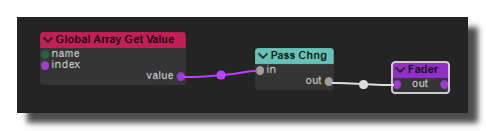 this option is equivalent to this patch
Common Settings
info
show manual
Button. Opens the manual page of the selected object (or of its parent module for a control) in the web browser. If no page exists for this object, an error is traced in the trace panel.
For more details about information/help creation, see create-help-file.
description
Free multi-line text attached to the module, saved with the patch. When it is not empty, it is shown as the hint of the module (mouse over the module header in the patch) in place of the default module hint, even when the module hints are disabled.
ID's
visible only in god mode, see setup-panel-tab-expert.
unique ID
Read-only, not saved. Current private numeric ID of the object, used internally to identify it (for example as the target of a bind ID).
preset ID
Read-only, not saved. Private ID used to store and recall the values of this control in presets.
recreate ID
Button. Generates a new unique ID, original ID and preset ID for the object. Use it if you experience difficulties in Polyphonic mode or if two objects share the same ID. Preset values and binds referring to the old IDs are lost.
Object Remote Address
absolute
Read-only, not saved. Absolute address of the object in the Usine objects tree, built from the workspace root. This is the address to use to reach the object from scripts, the objects panel or remote messages. Only shown for objects that are registered in the objects list. See objects-address.
local
Read-only, not saved. Address of the object relative to the current patch, valid inside that patch only. See objects-address.
user addr
Free user-defined address for the object (empty by default). When set, the object is also registered in the objects tree under this name, so it can be reached independently of its position in the workspace (the value is also reported in the mouse-over and mouse-down chunks). Changing it rebuilds the objects list. Only available on objects that support a user address. See objects-address.
See also
- Tutorial : Global Arrays
- Global Array
- Global Array COLOR
- Global Array COLOR Get Array
- Global Array Reset
- Global Array Watch Modified
- Global Array Trigger Set
- Global Array Save Load File
- Global Array COLOR Set Array
- Global Array COLOR Set Value
- Global Array DATA OSC
- Global Array DATA Get Array
- Global Array STRING Set Comma Text
- Global Array STRING Set Value
- Global Array STRING Get Comma Text
- Global Array DATA Get Value
- Global Array COLOR Get Value
- Global Array STRING
- Global Array DATA
- Global Array Refresh Remote
- Global Array DATA Set Array
- Global Array DATA Set Value
- Global Array Trigger Get
- Global Array STRING Get Value
- Global Array Trigger
version 7.0.250921
Edit All Pages