Data Filter Spring
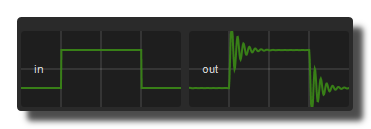
Spring physics model. The output follows the input as if attached by a spring: it overshoots, bounces back, and eventually settles. The behavior is controlled by three physical parameters: stiffness, damping, and mass.
Use it for bouncy UI animations, physics-based modulation, or any transition that should feel elastic and organic rather than linear. With high damping, it acts as a smooth filter with no overshoot. With low damping, it creates visible oscillation around the target value.
Settings
bypass
Bypasses the module processing when activated (ON).
- OFF (0): Module processes normally
- ON (1): Input passes directly to output without processing
in
Input Data flow(s).
out
Output Data flow(s).
stiffness
Spring stiffness constant. Higher values make the spring snap to the target faster, but with more oscillation if damping is low.
damping
Damping coefficient. Controls how quickly oscillations decay.
- Low damping: bouncy, oscillating response.
- High damping: smooth approach with little or no overshoot.
mass
Mass of the spring-attached object. Higher mass means more inertia: the output responds more slowly and oscillates with wider swings.
Common Settings
info
show manual
Button. Opens the manual page of the selected object (or of its parent module for a control) in the web browser. If no page exists for this object, an error is traced in the trace panel.
For more details about information/help creation, see create-help-file.
description
Free multi-line text attached to the module, saved with the patch. It is only meant as an internal note for the patch designer: it is not displayed in the interface.
ID's
visible only in god mode, see setup-panel-tab-expert.
unique ID
Read-only, not saved. Current private numeric ID of the object, used internally to identify it (for example as the target of a bind ID).
preset ID
Read-only, not saved. Private ID used to store and recall the values of this control in presets.
recreate ID
Button. Generates a new unique ID, original ID and preset ID for the object. Use it if you experience difficulties in Polyphonic mode or if two objects share the same ID. Preset values and binds referring to the old IDs are lost.
Object Remote Address
absolute
Read-only, not saved. Absolute address of the object in the Usine objects tree, built from the workspace root. This is the address to use to reach the object from scripts, the objects panel or remote messages. Only shown for objects that are registered in the objects list. See objects-address.
local
Read-only, not saved. Address of the object relative to the current patch, valid inside that patch only. See objects-address.
user addr
Free user-defined address for the object (empty by default). When set, the object is also registered in the objects tree under this name, so it can be reached independently of its position in the workspace (the value is also reported in the mouse-over and mouse-down chunks). Changing it rebuilds the objects list. Only available on objects that support a user address. See objects-address.
See also
version 7.0.250921
Edit All Pages