Array Expand Compress
Resizes an array by expanding or compressing it using interpolation. The output size equals factor x input size.
For example, a 512-element input with factor = 0.5 produces a 256-element output, and factor = 2 produces a 1024-element output.
Useful for stretching or shrinking spectra, lookup tables, or any array data.
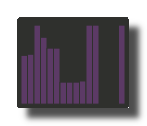 input array
 expand with factor=2
 expand with factor=0.5
Settings
bypass
Bypasses the module processing when activated (ON).
- OFF (0): Module processes normally
- ON (1): Input passes directly to output without processing
array in
Array input flow(s).
array out
Array output flow(s).
factor
Compress expand factor:
- if factor < 1, provides a compression.
- if factor > 1, provides an expansion.
- if factor = 1, no changes.
mode
Interpolation mode used to calculate the new array:
- linear interpolation -- blends between neighboring values for smooth results. Best for audio and continuous data.
- accumulation -- adds input values into the nearest output bin. Useful for histograms or spectral data.
newIndex = trunc(factor*oldIndex); output[newIndex] := output[newIndex]+input[oldIndex] - no interpolation -- nearest-neighbor mapping, no blending. Best for arrays of discrete values such as colors or indices.
 inIndex = trunc(outIndex/factor);
 output[outIndex] := input[inIndex]
Common Settings
info
show manual
Button. Opens the manual page of the selected object (or of its parent module for a control) in the web browser. If no page exists for this object, an error is traced in the trace panel.
For more details about information/help creation, see create-help-file.
description
Free multi-line text attached to the module, saved with the patch. It is only meant as an internal note for the patch designer: it is not displayed in the interface.
ID's
visible only in god mode, see setup-panel-tab-expert.
unique ID
Read-only, not saved. Current private numeric ID of the object, used internally to identify it (for example as the target of a bind ID).
preset ID
Read-only, not saved. Private ID used to store and recall the values of this control in presets.
recreate ID
Button. Generates a new unique ID, original ID and preset ID for the object. Use it if you experience difficulties in Polyphonic mode or if two objects share the same ID. Preset values and binds referring to the old IDs are lost.
Object Remote Address
absolute
Read-only, not saved. Absolute address of the object in the Usine objects tree, built from the workspace root. This is the address to use to reach the object from scripts, the objects panel or remote messages. Only shown for objects that are registered in the objects list. See objects-address.
local
Read-only, not saved. Address of the object relative to the current patch, valid inside that patch only. See objects-address.
user addr
Free user-defined address for the object (empty by default). When set, the object is also registered in the objects tree under this name, so it can be reached independently of its position in the workspace (the value is also reported in the mouse-over and mouse-down chunks). Changing it rebuilds the objects list. Only available on objects that support a user address. See objects-address.
See also
- MIDI to Array (SCRIPT)
- Video to Data Array
- Array
- Array Max Position
- Store Array (SCRIPT)
- Array Copy To
- Array Average
- Array Chaser
- Array Min Value
- Array Duplicate
- Array Normalize
- Array Replace
- Array Max ABS Value
- Array Mid Value
- Array Fill
- Array Max Value
- Array Insert
- Array Expand Compress
- Array Smooth Values
- Array Max - Min Value
- Array Set Size
- Array Concat
- Array Delete Value
- Array Standard Deviation
- Array Unpack
- Array Reverse
- Array Crop
- Array Get Size
- Array Split
- Array Sum
- Array Delete
- Array Combine
- Array Get Element Values
- Array Min Position
- Array Set Element Values
- Array Gate
- Array Recursive Add
- Array Difference
- Array Delay
- Array Remove Duplicates
- Array Contains
- Array Find Index
- Array Queue Data
- Array Repeat
- Array Combine Inverse
- Array Random
- Array Roll
- Array Editor
- Array Limit Size
- Array Affect One by One
- Array Clip
- Array Difference Array Out
- Array Shift
- Array Shuffle
- Array Fill Ramp
- Array Extract
- Array Sort
- Array Display
- Data Generator Random Pattern Array (SCRIPT)
- Comma-Text to Array (SCRIPT)
- Array to Comma-Text (SCRIPT)
version 7.0.250921
Edit All Pages