SYNTH OS-Synth-C
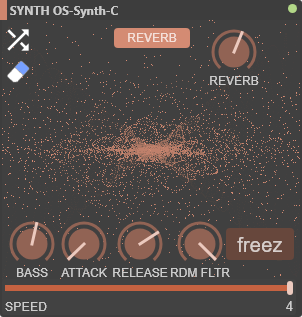
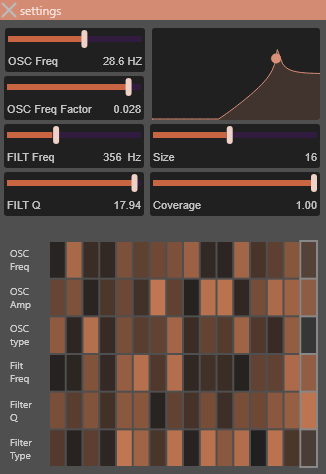
Synthesizer driven by a step grid. In the settings window, each line of the grid is a parameter of the sound (oscillator frequency, amplitude and type, filter frequency, resonance and type) and each column a step. The panel holds the randomize and reset icons, a reverb, an XY oscilloscope that draws the output, and knobs for the bass, the envelope and the random filter.
In the library: 1-Audio > Audio Synthesis.
Settings
randomize
The shuffle icon: draws new random settings.
reset
The eraser icon: resets the settings.
REVERB
The knob sets the level of the reverb, from -80 to 12 dB. The REVERB switch next to it turns the reverb ON or OFF.
Oscilloscope XY
The dark area of the panel: draws the audio output as an XY figure.
BASS
Bass, from 0 to 0.95.
ATTACK
Attack time of the envelope, from 0 to 100 ms.
RELEASE
Release time of the envelope, from 0 to 500 ms.
RDM FLTR
Random filter, from 0 to 1.
freez
ON: freezes the sound.
SPEED
Speed, from 1 to 4.
Settings window
advanced settings
 Use this icon in the patch header to open these advanced settings. Like the other icons of the header, it shows when the mouse is over the control panel of the patch (the green dot, always shown, turns the patch ON or OFF).
OSC Freq
Frequency of the oscillator, from 20 to 100 Hz.
OSC Freq Factor
Frequency factor of the oscillator, from -0.12 to 0.04.
FILT Freq
Cutoff frequency of the filter, from 20 to 20000 Hz.
FILT Q
Resonance of the filter, from 0.3 to 20.
Size
Number of steps (columns) of the grid, from 2 to 32.
Coverage
Coverage, from 0 to 1.
grid
The step grid. Its lines are named OSC Freq, OSC Amp, OSC type, Filt Freq, Filter Q and Filter Type; each column is a step. The shade of a cell shows its value; the lighter column is the current step.
See also
version 7.0.250921
Edit All Pages